LIMRA: DC Plan Advisors Skeptical of Alternative Investments, For Now…
5/28/2026
In August 2025, the White House issued an Executive Order to open the possibility of including alternative investments in employer-sponsored, DC plans. Traditionally, DC plan investment options are usually structured as mutual funds or mutual-fund-like investments — i.e., collective investment trusts (CITs) and exchange-traded funds (ETFs) which usually invest in publicly traded securities (stocks, bonds, or cash/cash equivalents).
Alternative investments sit outside of these categories, offering access to investments in a broad range of classifications, which can include private equity and credit, real estate, “real” or tangible assets, and cryptocurrency. Until recently, the role of these alternative investment types in the universe of DC plans has been quite limited. Expanding DC plans’ access to alternative investment types may offer an opportunity for greater returns but also introduces potentially greater investment risk.
Although there are regulatory hurdles to overcome before these investments become more common, the EO ordered several agencies to examine and propose regulations and guidelines to make these alternative asset investments available to participants in participant-directed, defined-contribution, retirement savings plans.
A new LIMRA study, DC Advisor Views Advisors and Alts, finds few plan advisors (17%) are very familiar with the 2025 EO on alternative investments. In general, most are very skeptical about introducing these types of investments into their clients’ plans.
“This lack of knowledge and skepticism is important because plan sponsors’ most common source for regulatory and legislative updates are their DC plan advisor,” noted Deb Dupont, assistant vice president and head of LIMRA Institutional Retirement Research. “Plan sponsors are more likely to act upon their advisor’s guidance. To date, a majority of plan advisors believe these new asset classes are too complicated for plan sponsors and participants to fully understand.”
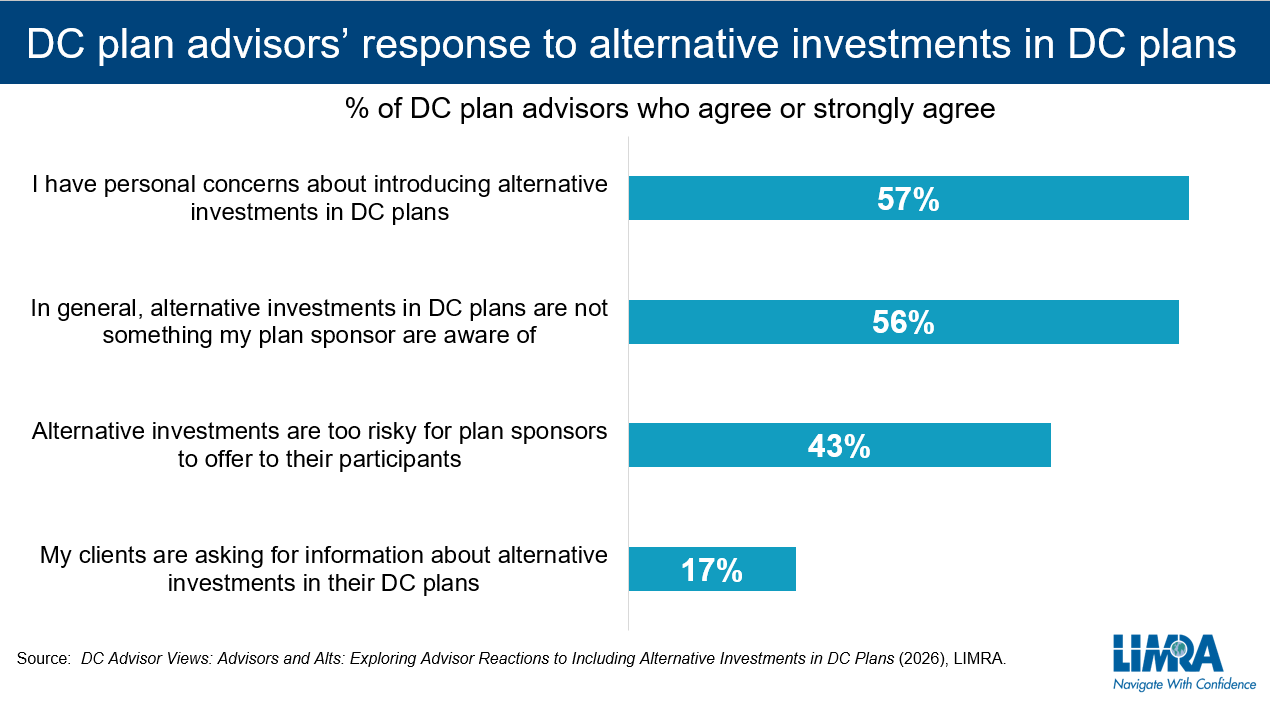
The study also revealed that advisors view all alternative investments the same way.
- Among non-traditional asset classes, advisors are more knowledgeable about real estate than other listed asset classes and are more likely to feel that real estate has a place in a DC plan.
- They are least bullish on cryptocurrency, with just 31% giving themselves top marks for understanding this asset type, and only 8% feeling it is appropriate for a DC plan.
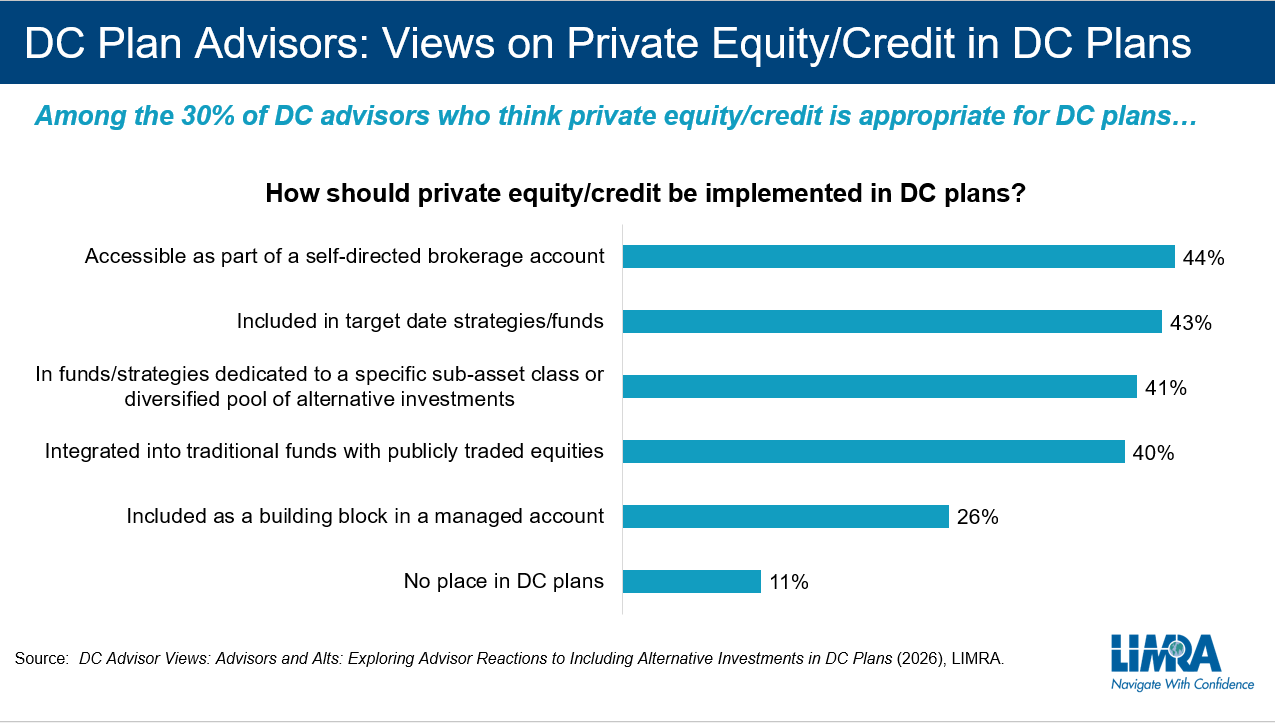
- Although the majority are familiar with them, only 30% of advisors feel that private equity and private credit should be integrated into DC plan investment vehicles, such as managed accounts, brokerage accounts, asset allocation fund strategies, and dedicated funds.
DC plan advisors ranked private equity and private credit among the least appropriate investments to include in their clients’ DC plans. Despite concerns, DC plan advisors offered their opinions on how alternative investments could be responsibly included into a DC plan: the highest ranked include self-directed brokerage accounts and target-date funds/strategies.
“Technology has created many new opportunities for the world of investments to expand,” said Bryan Hodgens, senior vice president and head of LIMRA Research. “Yet, because of critical role DC plans has in helping to support financial security in retirement, DC plan advisors, plan sponsors and possibly plan participants are cautious of these new investment classes and the added risk they may present.”
As the federal government builds the regulatory structure to allow these into what is often Americans’ primary retirement savings vehicle, DC plan advisors are looking to recordkeepers for:
- Educational resources — clear, accessible materials to help sponsors understand the risks, benefits, and mechanics of alternative investments (82%)
- Regulatory and compliance guidance — resources to help sponsors navigate fiduciary responsibilities and evolving regulatory standards (74%)
- Operational support — guidance on implementation logistics, such as plan design, recordkeeping, and administrative processes (71%)
- Investment modeling tools — analytical tools to illustrate potential portfolio outcomes, risk/return trade-offs, and diversification benefits of alternatives (67%)
- Peer benchmarking data — insights into how other plan sponsors are using (or avoiding) alternative assets to inform decision-making (59%)
It’s too soon to know what the impact will be from the inclusion of alternative (investments) and crypto in retirement plans but like any industry change, LIMRA’s research suggests transparency, education and established industry standards often lead to the best outcomes.
To watch the latest Industry Insights with Bryan Hodgens, visit Exploring DC Plan Advisors’ Views About Alternative Investments and Pooled.