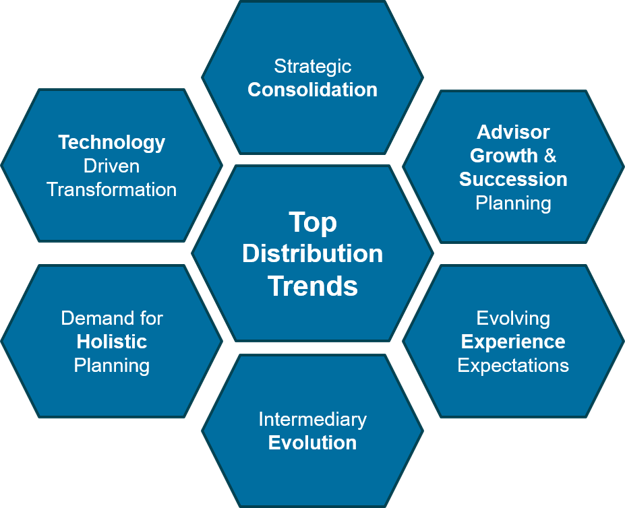
Distribution leaders today aren't contending with a single disruptive trend — they're navigating six at once, and that convergence is what sets this moment apart. New LIMRA research, based on interviews with industry leaders and distribution executives, identifies six forces reshaping how financial services products reach the market: strategic consolidation, advisor growth and succession planning, shifting consumer expectations, technology transformation, intermediary evolution, and growing demand for holistic planning.
Each of these trends carries weight on its own. But the more significant finding is how closely interconnected they've become.
Talent Transition Is Becoming a Defining Industry Challenge
Over the next decade, the industry expects a wave of advisor retirements alongside broader workforce shifts. Firms are managing succession planning, recruiting new talent, and facilitating knowledge transfer across generations of advisors—all at the same time.
Cross-generational mentorship is one approach gaining real traction. Industry leaders pointed to the value of both traditional mentoring and reverse mentoring, where experienced advisors pass on planning expertise and client management skills, while younger advisors help teams build capabilities in social media, digital engagement, and adaptability.
The urgency is real. LIMRA research shows firms need to stay aggressive about recruiting and developing new advisors as retirements accelerate. Building the next generation of distribution talent is no longer a long-term initiative—it’s a strategic priority now.
“Developing the next generation of talent really has to become a top priority.”
-
- Cindy Hoes, Head of Distribution Research, LIMRA
Consumers Expect Both Digital Convenience and Human Guidance
Consumer expectations keep evolving, particularly among younger generations.
Research from LIMRA and Capgemini found that consumers increasingly want a “phygital” experience—a seamless blend of physical and digital interactions. They want the flexibility to research products online, use self-service tools, and engage through mobile channels, while still having access to a trusted human advisor when they need one.
At the same time, trust and personal relationships still matter enormously, especially for major financial decisions. Industry leaders believe the firms that get this balance right—digital enablement paired with genuine human engagement—will be the ones best positioned to compete.
Workplace benefits providers offer a good example of what that looks like in practice. During major life events—filing a claim, experiencing a family tragedy—consumers expect both speed and empathy. Delivering both at once takes real coordination across technology, operations, marketing, and service teams.
“Those firms that really think through what their customers need, where they need human interaction versus what can be automated, are going to be the winners.”
-
- Cindy Hoes, Head of Distribution Research, LIMRA
Technology Is Accelerating Transformation Across Distribution
Technology emerged as a recurring theme across every area of the research.
Industry leaders cited artificial intelligence, automation, data integration, and digital infrastructure as key enablers—helping firms improve operational efficiency while enhancing both advisor and client experiences. At the same time, organizations are navigating new challenges around cybersecurity, compliance, trust, and risk management.
Technology is also reshaping how intermediaries operate. Leading IMOs are increasingly evolving into integrated technology platforms, giving advisors a centralized ecosystem for marketing automation, lead generation, quotes, e-applications, and workflow management.
Across the industry, technology investments are focused on one thing: simplifying routine processes so advisors can spend more time serving clients.
“It’s not about taking the advisor out of the process. It’s about using technology and tools to help improve advisor-led experiences and efficiencies.”
-
- Cindy Hoes, Head of Distribution Research, LIMRA
AI is expected to play an especially important role. Emerging advisor tools can cut down administrative work, support lead generation, provide real-time coaching during client conversations, and surface next-best-action recommendations. Distribution leaders are now evaluating how to integrate these capabilities into advisor workflows and training programs.
Consolidation Continues to Redefine the Competitive Landscape
Strategic consolidation remains a powerful force across the financial services ecosystem.
As firms combine, the focus is shifting—away from simply expanding advisor counts or product shelves, and toward building differentiated capabilities in product development, practice management, technology, and client experience.
Research participants noted that mergers and acquisitions are creating larger, more sophisticated platforms while also reshaping carrier distribution strategies. The result is an environment where traditional channel distinctions matter less, and independent firms continue to gain influence.
For carriers and distributors, staying ahead of how advisors are evolving their business models—whether through fee-based planning, holistic wealth management, or other advisory approaches—will remain critical to sustaining growth.
The Future Belongs to Organizations That Can Connect the Dots
Perhaps the most important takeaway from LIMRA’s research is that these trends shouldn’t be viewed in isolation. Talent shortages, evolving consumer expectations, technology adoption, advisor productivity, succession planning, and consolidation are all happening at once—and all influencing each other.
For distribution leaders, success will come down to addressing these forces holistically. The firms that invest in talent, embrace technology thoughtfully, build seamless client experiences, and adapt to a shifting distribution landscape will be the ones best positioned for growth.
“These forces truly are reshaping how insurers, providers, and intermediaries compete, invest, and position themselves for future growth.”
-
- Cindy Hoes, Head of Distribution Research, LIMRA
LIMRA members can access additional research and white papers examining each of the six forces through LIMRA’s Distribution Research program. To watch the full Industry Insights episode featuring Cindy Hoes, Head of Distribution Research, visit LIMRA’s LinkedIn page.