LIMRA: What Employees Really Think About Their Workplace Benefits
7/1/2026
Economic pressure is reshaping how American workers feel about their workplace benefits. LIMRA’s Benefits and Employee Attitude Tracker (BEAT) study, now in its fifth year, surveys roughly 4,000 U.S. employees annually to measure satisfaction, financial vulnerability, and attitudes toward workplace benefits. The latest findings reveal both encouraging trends and persistent gaps that should concern employers and carriers alike.
Satisfaction Is Up, But Employers Are Overestimating It
Forty-five percent of employees are very satisfied with their benefits, with three quarters at least somewhat satisfied, which is up four percentage points from last year. LIMRA researchers link the improvement to “job hugging,” a trend in which employees, wary of a tighter job market, are more inclined to stay put and view their current situation more favorably. However, when employers were asked the same question about their own workforce, 84% believed their employees were very satisfied—nearly double the actual figure.
“If employers are overestimating how satisfied their workers are, they think everything’s already great. They’re going to be a lot less motivated to make enhancements to their benefits packages and that ultimately puts them at risk of losing workers to competitors.”
— Kim Landry, Research Director, Workplace Benefits, LIMRA

Rising Health Costs Are Creating Downstream Risk
More than three-quarters of employees saw their health insurance premiums rise in 2026, and more than four in ten faced increases greater than five percent. When premiums went up, roughly half of workers made changes, often at the expense of other coverage: 16% reduced spending on other benefits, 12% cut retirement savings contributions, and 9% chose not to enroll in some additional benefits at all. Younger workers felt this most acutely; nearly three-quarters of Gen Z employees made some kind of change in response to rising medical premiums, and they were the most likely to reduce spending on nonmedical benefits.
This dynamic compounds an already troubling protection gap. Almost three-quarters of workers say their household would struggle to cover living expenses within a few months if they became unable to work, and more than half would face the same scenario if a breadwinner died unexpectedly.
“We had asked the same question about life insurance back in 2017 — almost a decade ago. When I compare the data then to the data now, we see that people are actually less prepared for this now than they were almost ten years ago.”
— Kim Landry, Research Director, Workplace Benefits, LIMRA

Communication, AI, and the Human Factor
Forty-five percent of employees only hear about their benefits during annual open enrollment, yet 73% want to receive information several times a year. No single communication channel dominates, making a multichannel approach essential. Notably, 70% want at least one channel that allows them to talk to a real person, up seven percentage points over four years.
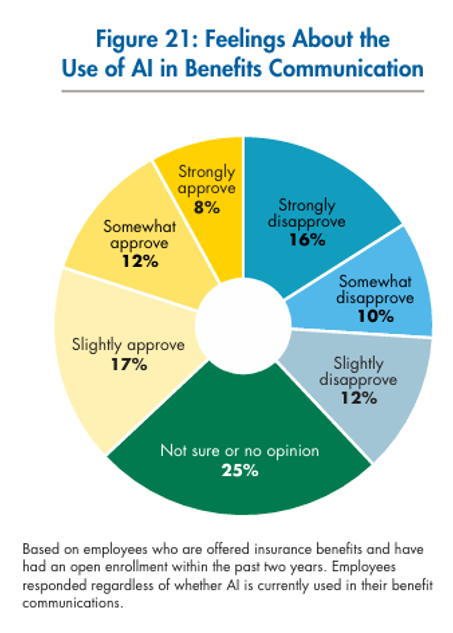
AI is generating significant industry interest as a benefits communication tool, but employee opinion is nearly evenly split: 37% approve, 38% disapprove and strong disapprovers outnumber strong approvers two to one. Employees who approve of using AI in benefits communication are hoping it will provide quicker answers to their questions, information that is easier to understand, and more personalized guidance. Employees who push back raise concerns about accuracy and data privacy that carry real legal exposure if not properly managed
“Whether it’s AI or another solution, the pain points employees are describing — slow answers, confusing information, lack of personalization — are the problems the industry needs to solve. These are the struggles your customers are having.”
— Kim Landry, Research Director, Workplace Benefits, LIMRA
Among employees who are very satisfied with their benefits, 77% are also satisfied with their jobs overall. In addition, two-thirds of workers say their benefits make them more inclined to stay with their current employers. For the industry, the BEAT findings point to a clear mandate: close the perception gap, expand benefits breadth, and build year-round communication strategies that meet employees where they are.
“A high-quality benefits package is a really powerful tool for promoting employee loyalty. But an inadequate benefits package — one that’s not meeting needs — could actually drive workers away.”
— Bryan Hodgens, Head of Research, LIMRA
LIMRA members can download the full BEAT study at limra.com. To watch the full Industry Insights episode featuring Kim Landry, research director for workplace benefits, visit LIMRA’s LinkedIn page.